

María del Mar Buendía Gómez
Estudiante de Derecho y Ciencias Políticas en la Universidad de Granada
1. The new geopolitical threat: digital security and defence.
Imagine a world where only one country possesses all the necessary material to manufacture every essential product. This is exactly our reality. The data-driven era is reshaping the whole structure of the world as we know it. A century ago, the country that had access to raw materials or cheap labour was the one with sovereignty over the global economy. Right now, power resides in the availability and rights over the analysis of big data. From the building of infrastructures, military operations, commerce or even social media; all of these functions depend 90% on data managed solely by US tech giants such as Google, Amazon, Microsoft or Meta.
Cloud Storage is not ethereal, it comes from physical serves located in the United States. This means that suppliers like Amazon Web Services (AWS), Microsoft Azure and Google Cloud; control 70% to 80% of Europe’s commerce and main information. This is not only a threat to global commerce, but also a direct menace to security and defence. The level of control the US has over the fate of Europe is highly concerning, in addition to the significant influence the internal legislative changes can have over all Europe. This legal threat was exemplified by the US CLOUD Act (Clarifying Lawful Overseas Use of Data Act). As a US federal law with extraterritorial reach, it affected every state in the world, giving permission to the US government to compel US technology companies (the ones who have access to all of our data) to give all the stored data regardless of which state it comes from.
This kind of intrusion is so serious that if it was physical, it would be considered an unacceptable violation to national sovereignty and international law. Our digital realm leaves European businesses, citizens and institutions defenseless against the “hijacking of jurisdiction”, where the US government can access sovereign data at any moment.
2. The European Initiative is no longer a suggestion.
The EU Commission is addressing this, aiming to give enterprises and public European authorities access to internal independent infrastructures. Initially just a suggestion, the initiative soon turned into an obligation. It does not imply European isolation, nor a diminution of international cooperation; but acquiring a capacity to decide, operate and evolve in digital infrastructures without depending on external legislative changes or US commercial interests.
In 2026 the Commission will propose The Cloud and AI Development Act, which aims to triple the capacity of EU data centres in the next five to seven years. Avoiding falling behind in AI development, the organisation has invested 200 billion Euros in “InvestAI”, trying to
enhance Europe’s supercomputer capabilities. However, these individual initiatives need a global strategy that aims to achieve true digital sovereignty: The Eurostack.
3. Eurostack: Three layers to Digital Independence.
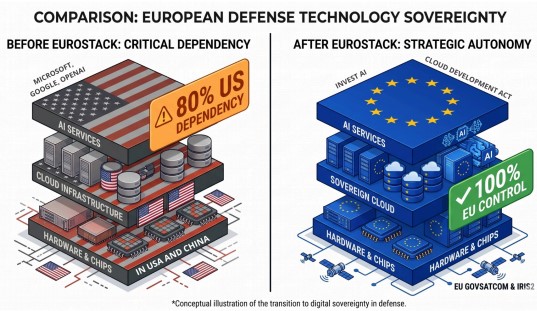
Image generated by Gemini AI (2026) based on architectural data from Infodefensa and Cosmos Factory.
This is the shared strategic vision to achieve complete digital independence in Europe, divided in three layers.
First, the Hardware, the physical aspect of the digital realm. PC components, microchips, and big infrastructures, currently located in the USA and China. Regarding this level, Europe is developing sovereign satellite infrastructures, such as the EU GOVSATCOM and IRIS2 programs.
Second, the cloud system. These include sovereign operating systems, secure data spaces, and European digital identity wallets like eIDAS. Nowadays, this data is 80% owned by the USA, but Eurostack aims to transition it to 100% European control.
The third base is Artificial Intelligence, overwhelmingly dominated by US giants. In this layer, Eurostack focuses on two shifts: creating AI engines trained specifically on European languages, cultures, and data; and making public investment in AI but with strict conditions regarding principles of openness, public interests and transparency.
4. Digital Autonomy: An Urgent Objective.
Europe´s digital autonomy is not a luxury, but a necessity. If the EU fails to achieve Eurostack’s goals, extraterritorial legislative and geopolitical shifts may put our digital
security at risk, creating an even more pronounced dependence on external interests. As the 2026 Cloud and AI Development Act and Eurostack initiative continue moving forward, Europe is finally turning its efforts from resisting external changes (such as the extraterritorial reach of the US CLOUD Act) to building 100% European Hardware, Cloud and AI tools.
Bibliography
- Oliver Llorente, P. (2025, April 24). El reto de la soberanía tecnológica: hacia un ecosistema digital europeo propio. Real Instituto Elcano.
- Romero, G. (2025, March 3). Soberanía digital de la UE: ¿cómo reducir la dependencia tecnológica? Campus ETIC.
- Sotillos, L. (2026, January 26). ¿Qué es el Eurostack? Soberanía digital europea para reducir su dependencia de EE. UU. Novatierra
- Bria, F., Ryan, J., Bloemen, S., Pfeffer, M., Saari, L., Ferrari, F., van Dijck, J., van den Bosch, A., & Pesole, A. (2024, December). Time to build a European digital ecosystem: Recommendations for the EU’s digital policy. Foundation for European Progressive Studies (FEPS) & Friedrich-Ebert-Stiftung (FES)